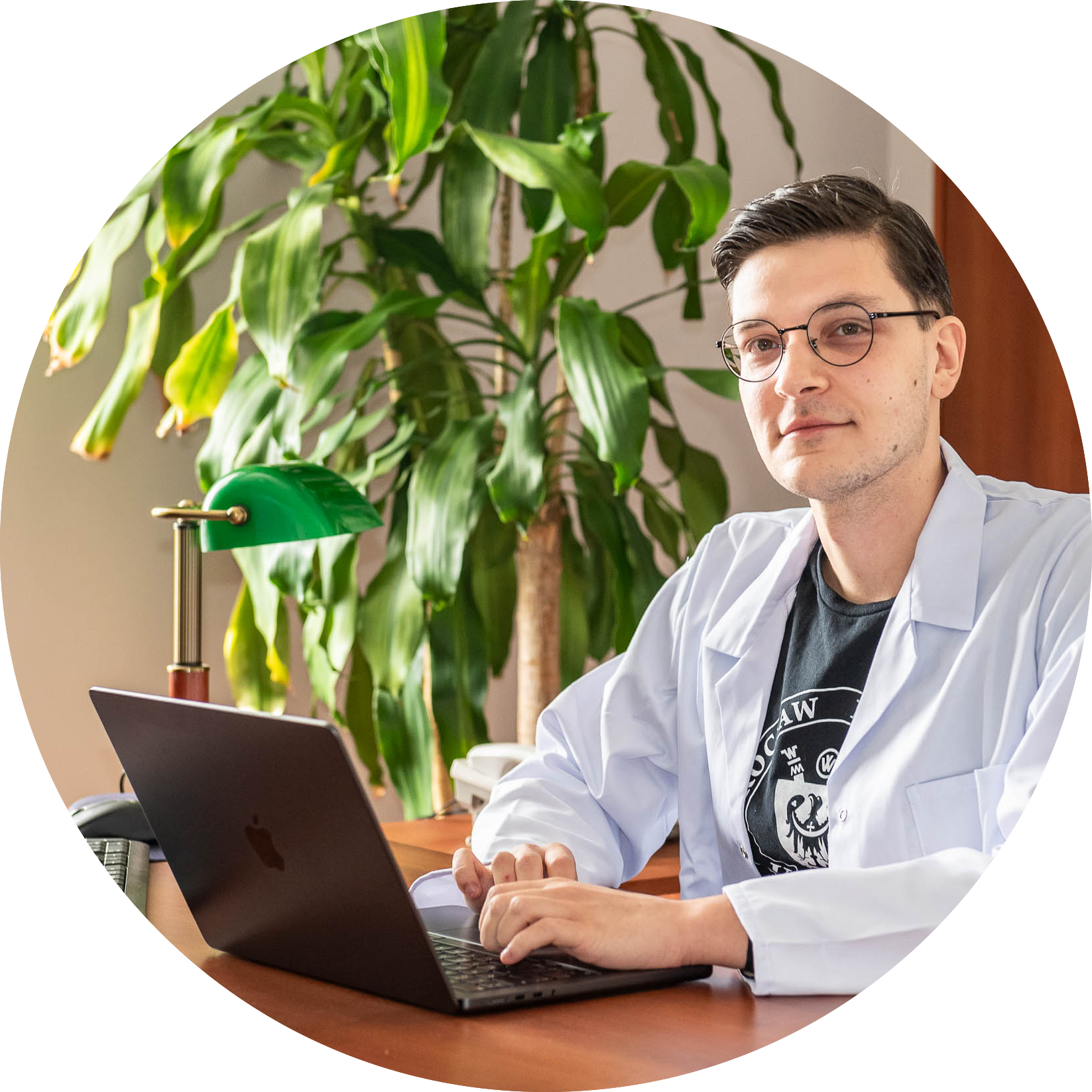
Assistant Professor at Department of Organic Chemistry and Pharmaceutical Technology, Wrocław
Medical University.
“Combining the precision of quantum chemistry with the complexity of biological systems, to
architect the next generation of therapeutic agents.”
— on why in silico chemistry matters for pharmacy
51Publications
1,026Citations
15h-index
218.9Cumulative IF
About
A pharmacist who works on the other side of the screen.
I'm a pharmacist by training (MPharm, ) and
hold a PhD in pharmaceutical sciences () from
Wrocław Medical University, where I specialised in
computational modelling of antioxidant
mechanisms. My academic path took a sharp turn early on — by the third year of my master's, I
had already swapped the pharmacy counter for computational chemistry algorithms.
Looking for a fixed roster of projects? You won't find one — they change faster than I can
update this
website. My scientific toolbox is just as restless, continuously evolving and currently split across
the three pillars you'll find below (besides all the others!).
Antioxidants make up the bulk of my publication record — they were my launching pad.
Photosensitisers,
meanwhile, are steering my habilitation journey. But if there's one constant in my work, it's a
relentless curiosity and a hunger for the next big idea, collaboration, or unexpected opportunity.
What that toolbox actually looks like
Quantum mechanics
DFT, TD-DFT and ab initio methods — detailed thermochemistry, kinetics, and
excited states
analyses.
Molecular dynamics
Membrane systems and protein–drug binding including classical MD, QM/MM and steered MD.
Enzymatic docking
Structure-based virtual screening for enzyme targets.
Quantum computing
Exploring ansatz-based algorithms for molecular Hamiltonians — early days, but the
perspective shift is electrifying.
Research
Three questions I keep coming back to
Roughly fifty publications cluster around the three themes below —
antioxidants, photodynamic therapy, and drug & method design. They're the three biggest
clusters, not an exhaustive map.
Pillar I
Antioxidant & free-radical chemistry
Unpicking how flavonoids, phenolic acids, and anthocyanidins (and others!)
neutralise reactive
oxygen species — acid–base speciation, competing HAT/SET/RAF mechanisms, metal
chelation, and even the
repair of biomolecules that have already been oxidised. Includes senotherapeutic properties.
Pillar II
Photodynamic & photophysical design
Using TD-DFT to decode photosensitiser efficiency — one- and
two-photon absorption, excited state
dynamics, and reactivity in type I, II and III mechanisms. Natural dyes and metal
complexes each offer a distinct photophysical pathway to exploit.
Pillar III
Computational craftsmanship for drug design
The methodological engine that ensures every prediction holds up.
Benchmarking methods,
developing computational tools, and providing reproducible workflows and Python‑driven
automation that inform drug design. Enclosed within the other research projects for now —
but
gradually crystallizing into a pillar of its own.
Selected work
Six papers, if that's all you have time for
Picked for different reasons — highest impact factor, an award, a mentee's first paper, a
stretch
outside the usual topics, and a cornerstone of the senolytics thread. The full, chronological
list of all is further down, under Publications.
Expertise
Current Trends in Computational Quantum Chemistry Studies on Antioxidant
Radical Scavenging
Activity
J. Chem. Inf. Model. · · IF 6.162 — cover article; sole author
Career progress rarely runs downhill in a straight line — closer,
maybe, to a potential energy surface: exploratory steps early on, a deep and stable minimum at the
doctorate, and a climb toward the next one now.
Funding & recognition
Grants and awards
National and international funded projects
NCN · PRELUDIUM 21
Artificial intelligence in the search for new natural
medicinal substances that lower
free-radical concentration in the body
Principal investigator, project 2022/45/N/NZ7/02264, National Science
Centre (Poland). Combines
experimental antioxidant assays with theoretical chemistry and Python-based QSAR models —
the
seed of Pillar I and III above.
Other funded projects
PI ·
Senolytic flavonoid derivatives
In silico modelling of fisetin analogues with geroprotective and
senolytic activity.
PI ·
Anticancer Pt(II) complexes
Computational design of heterocyclic ligands to tune Pt(II) reactivity
and DNA binding.
Co-I ·
Antimicrobial 2,7-naphthyridines
Docking and molecular dynamics of gyrase–DNA–inhibitor
complexes.
Co-I ·
H. pylori biofilm model
In silico screening of FDA-approved compounds targeting H.
pylori biofilm
metabolism.
Co-I ·
H. pylori biofilm under antibiotic pressure
Molecular interpretation of amino-acid profile dynamics in biofilm
matrix exposed to
antibiotics.
Awards
Early Career Collection 2025 & Beal Award nomination
Invitation to the Early Career Collection 2025 (J. Nat.
Prod., ACS) and nomination
for the Jack L. Beal Award (ASP) for best publication by an early-career scientist.
Polish Academy of Sciences (Wrocław Branch) Medal "Iuvenes Wratislaviae"
For scientific achievement, awarded in two consecutive editions.
World's Top 2% Scientists
Stanford
University & Elsevier
— ranked in the single-year impact list for 2023 and 2024.
Molecular Physics Early Career Researcher Prize 2024
Taylor & Francis — for the paper "Post-CCSD(T) corrections
to bond distances and
vibrational frequencies: the power of Λ".
Rector's First-Degree Individual Award
Wrocław Medical University — for significant and creative
scientific work, awarded in
consecutive years.
Golden OTIS Trust Award — "Scientific Debuts"
Scholarship and distinction for early-career research achievement.
Doctoral thesis with distinction
PhD in pharmaceutical sciences, Wrocław Medical University —
thesis „In silico
studies of the antioxidant activity of phytochemical compounds”.
Bibliography
Publications
Full archive of peer-reviewed articles charting ongoing research trajectories.
Papers belonging to the doctoral cycle are highlighted with a
violet border and papers belonging to the
habilitation cycle are highlighted with a
golden border.
Filter by year:
Media & Outreach
In the Press and Public
Interviews, popular-science features, and university press releases covering
my research.
Internationalization & Mobility
Research Stays and Conferences
Click any marker on the globe to view details about the research stay, host
institution, or conference presentation.
Home Institution Research Stay Conference
— Select a marker on the globe —
Collaborative Research & Consulting
Partnering with Students, Researchers, and Industry
For Students & Thesis Candidates
MSc & Thesis Supervision: Projects in molecular modeling, QSAR, and
computational photophysical/antioxidant chemistry.
Student Mentorship: Direct guidance through the Student Scientific
Circle—building on the research tradition I joined as a student.
Publication Opportunities: Co-authorship is standard practice; recent MSc
supervisees have published as co-authors in high-impact journals like Food
Chemistry.
In Silico Drug Triage: Early-stage computer-aided drug design (CADD) for
antioxidants, photosensitizers, and organometallic therapeutics prior to synthesis.
Custom Workflow Development: Method benchmarking and automated
QSAR/machine-learning pipeline development in Python.
Scientific Consulting: Expert consulting on molecular modeling, SAR
analysis, and reaction mechanism elucidation.